


Ownership Is Not Enough
Ownership Is Not Enough, Why Recovering Your Land Must Go Through the Courts.
Most landowners assume they can simply remove anyone from their land without right. A tenant who stays on after the tenancy ends. Workers or families who have farmed a plot for decades. Stalls that spread onto a vacant lot. A house, shed or place of worship built without permission. The instinct is to send in a contractor, clear the site and take the land back. That instinct can be expensive. The question has returned to public debate in recent weeks. The answer lies in a distinction with more than four decades of history: the right to possess land is not the same as the right to recover it by force.
The law once let owners help themselves
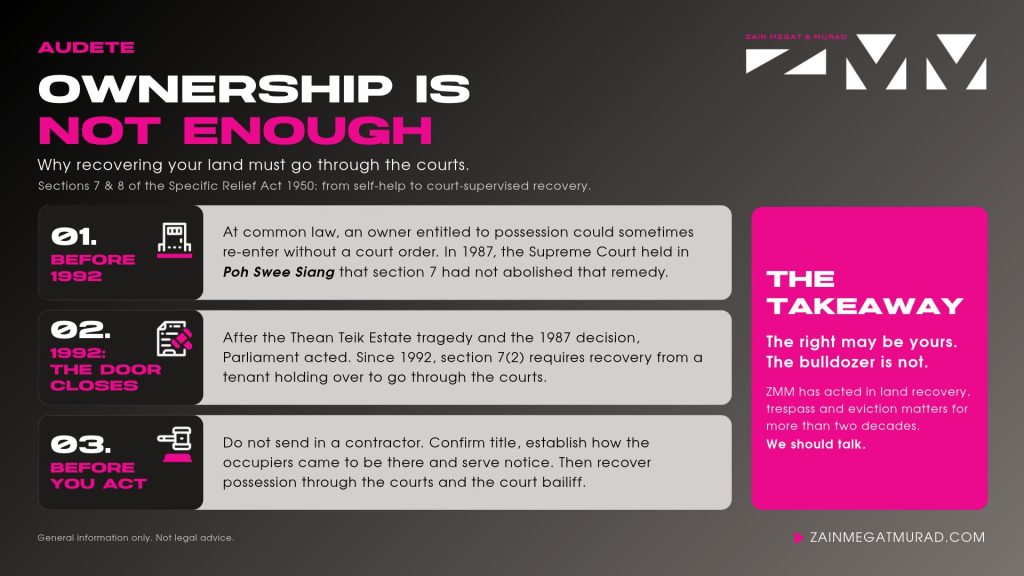
At common law, an owner entitled to possession could, in some circumstances, re-enter without a court order. This was the remedy of self-help. The Specific Relief Act 1950 provided that a person entitled to possession of immovable property may recover it through civil proceedings. The word “may” left the question open. Was going to court one option among several, or the only lawful route?
A dispute over land cost a life
In the early 1980s, hundreds of farmers occupied Thean Teik Estate in Penang. Some had cultivated their holdings as tenants for decades. The owners planned to redevelop the land for housing. In October 1982, the clearing of the estate turned into a confrontation. The Supreme Court later recorded evidence that vegetable plots were flattened, irrigation pipes destroyed and a female farm worker shot dead. The litigation reached the Supreme Court. In Trustees of Leong San Tong Khoo Kongsi (Penang) Registered & Ors v Poh Swee Siang, decided in April 1987, the Court held that the Act had not abolished self-help. The decision did not authorise violence. But it left owners free to act on their own view of a disputed right, and Thean Teik had shown where that could lead.
Parliament closed the door in 1992
Concerns that landowners and developers would rely on the decision to evict without court orders reached Parliament within months. When the amending Bill was debated in October 1991, the Minister of Justice explained that disputes between landlords and tenants over the recovery of possession should be resolved by the courts, not by the degree of force a party thought reasonable.
The Specific Relief (Amendment) Act 1992 came into force on 21 February 1992. Its effect:
- Section 7(2): where a tenancy has ended and the occupier remains, possession may only be recovered through court proceedings.
- Section 7(3): the occupier includes anyone lawfully in occupation when the tenancy ended.
- Section 8: a person dispossessed without consent and otherwise than in due course of law may sue to recover possession, even against a competing claim to title.
An owner who evicts by force may find the court ordering possession back to the occupier, whoever holds the title.
Not every occupier is a tenant, but that is no licence to demolish
Section 7(2) speaks to occupiers holding over after a tenancy. It does not, by its wording, cover every trespasser. That does not make self-help safe. The courts have strongly discouraged unilateral repossession, particularly where the occupation began lawfully or the eviction involves force or destruction of property.
Before deciding on a route, an owner needs answers to three questions:
- How did the occupiers come to be there? With permission, under a licence or tenancy, or without any consent at all.
- Has that permission ended? And was it ended properly?
- Is any other right asserted? A competing claim of entitlement must be tested in court, not on site.
Against persons who entered or remained without any licence or consent, Order 89 of the Rules of Court 2012 offers a summary procedure for recovering possession. Where the occupiers’ rights are genuinely disputed, ordinary civil proceedings may be needed. The same applies to unauthorised structures. A building used as a place of worship does not, by that use, confer ownership of the land or exemption from planning rules. Nor does a structure built without permission give the owner the right to demolish it personally. Local authorities hold their own statutory powers, including under the Street, Drainage and Building Act 1974. Those powers belong to the authority, not to the landowner.
Self-help can cost more than the land is worth
In August 2026, the Department of the Director General of Lands and Mines (JKPTG), with the Malaysian Bar Council, published a standard procedure manual on action against encroachment of private land. It expressly cautions owners against self-help evictions and unilateral demolition. An owner who clears the site without legal authority risks:
- Civil claims arising from the use of force or destruction of property.
- Criminal liability.
- Losing possession again under section 8, and with it time and leverage.
Five things to do before anyone touches a structure
- Do not send in a contractor. No demolition and no clearing without a court order.
- Confirm title and boundaries. Obtain a current title search and, where boundaries are uncertain, a survey.
- Establish how the occupiers came to be there. Gather tenancy agreements, letters, payment records and dated photographs of the site as it stands.
- Serve proper notice and open a conversation. Both are part of the lawful process before proceedings begin.
- Choose the right proceedings, then enforce through the court bailiff. Order 89 or a civil action, depending on the facts, with enforcement carried out under the court’s authority.
The order is only half the job
ZMM has acted in land recovery, trespass and eviction matters for more than two decades. These matters rarely turn on title alone. They involve longstanding occupation, competing claims, several families or businesses, and structures built up over years. Obtaining an order for vacant possession is one part of the work. Planning and carrying out its enforcement lawfully and safely is the other. Proper coordination, sensitivity to those affected and respect for the judicial process are what keep recovery orderly rather than confrontational.
The right may be yours. The bulldozer is not.
A landowner may be fully entitled to require unlawful occupants to leave. The law protects that right, but it insists on how it is enforced. Thean Teik is a reminder that a land dispute allowed to become a physical confrontation can cost far more than the land. If you need to recover possession, take advice before you take action.
If someone you know is about to clear occupiers or structures from their land, send them this article first.
We should talk.
The content of this article does not constitute legal advice. It is intended to provide general information. Specific advice should be sought in relation to your particular circumstances.
Zain Megat & Murad
D2-5-1 to D2-5-3A, Block D, Solaris Dutamas No.1, Jalan Dutamas 1, 50480 Kuala Lumpur
+603 6207 9331 | zmm@zainmegatmurad.com