


The Fixed-Term Contract Trap
The Fixed-Term Contract Trap: When “Temporary” Becomes “Permanent”
Seven annual contracts. One finance head. And a clause that said, in writing, he would never be permanent. The High Court said he was anyway.
Fixed-term contracts are one of the most common tools in a Malaysian employer’s kit. They keep headcount flexible, match staffing to projects and, the thinking goes, avoid long-term severance liabilities because the relationship ends cleanly when the term runs out.
That last assumption is where employers get caught. The courts look past the label on the letter to the employment underneath it. If what they find is a permanent role renewed on paper every year, the “expiry” is treated as a dismissal, and the employer must justify it like any other.
The test: what you do, not what you wrote
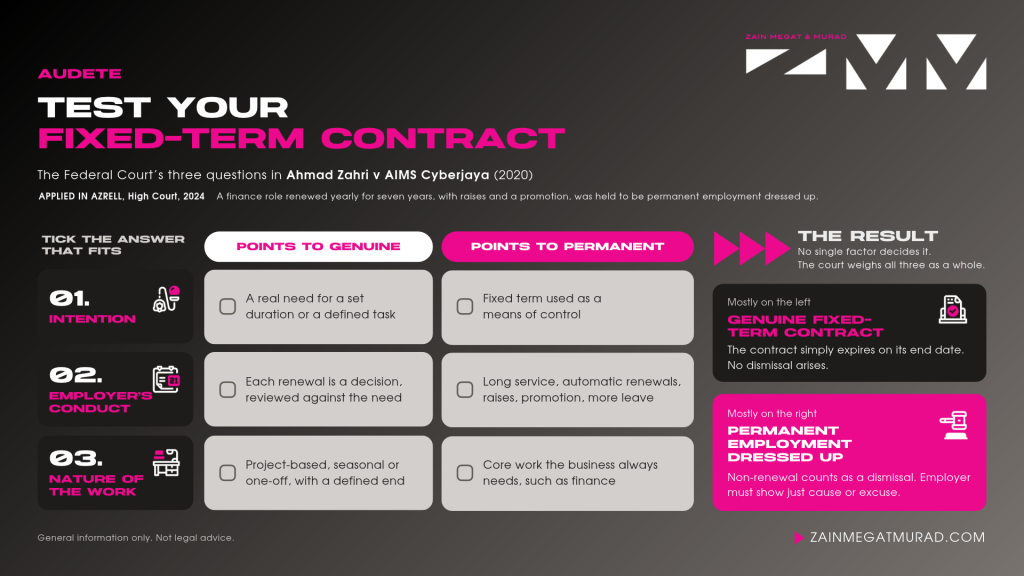
In 2020, the Federal Court in Ahmad Zahri Mirza Abdul Hamid v AIMS Cyberjaya Sdn Bhd framed the question plainly: is this a genuine fixed-term contract, or permanent employment dressed up as several fixed-term contracts?
To answer it, the court looks at three things:
- Intention. Did the employer genuinely need the employee for a fixed duration, or was the fixed term used as a means of control?
- Conduct during the employment. How long has the employee served? Were renewals automatic? Was the employee treated like permanent staff?
- Nature of the business and the work. Is the role project-based, seasonal or one-off, with a defined end? Or is it work the business will always need?
None of these turns on what the contract says. All of them turn on how the employer behaves.
When the paperwork isn’t enough
In Azrell Mohamad v National Aerospace & Defence Industries Sdn Bhd (High Court, 2024), a former Finance Manager was rehired in 2013 as General Finance Manager “on a contractual basis”. His contract was renewed every year for seven years. He was promoted to Senior General Finance Manager, received salary increments and more annual leave, and never had to apply for a renewal.
Each contract carried a clause stating that renewals would not make him permanent staff unless expressly stated. In January 2021, the company extended him by one month, then let the contract end.
The Industrial Court sided with the employer, relying on that clause. The High Court reversed it. The finance function was permanent in nature. Renewing the contract “unfailingly” for seven years showed the fixed term was “not out of genuine necessity but as a means of control and subjugation”. The ending was a dismissal without just cause or excuse, and the case went back to the Industrial Court to assess compensation.
The lesson is direct: a well-drafted disclaimer cannot outweigh seven years of conduct that says otherwise.
The hidden liability in “just renew it”
Each renewal feels like admin. Each one also adds to the record a court will read as a whole. Automatic renewals, no break, the same desk, a promotion, an increment: every item is evidence of permanence.
The cost arrives at the end. Once the employee is found to be permanent, the non-renewal is a dismissal and must be justified. If it cannot be, the Industrial Court can order reinstatement or compensation, and length of service weighs heavily in the sum. Seven years of renewals means seven years of service on the scale.
Moving staff between group companies won’t reset the clock
This is where the courts have been willing to pierce the veil, literally. In Ahmad Zahri, the employee moved from one AIMS group company to another after a consolidation. His new contract said it superseded all earlier contracts.
The Federal Court lifted the corporate veil anyway. The two companies were part of one group enterprise, so his employment ran continuously from 2009 to 2013. A fresh entity and a supersession clause did not start a new clock.
For foreign investors: the work permit is not the contract
Many businesses entering Malaysia place expatriate managers on fixed terms that track their work passes. The Federal Court in Ahmad Zahri was clear that citizenship and the need for a work permit have no bearing on whether employment is permanent. A foreign employee in a core, ongoing role can be a permanent employee like anyone else.
If your Malaysian entity was set up with that model, it is worth checking now.
Our answer: how to make a fixed-term contract hold
- Write down the reason. Name the project, season, funding period or temporary cover the role exists for. Tie the end date to it.
- Match the role to the reason. If the job is a core, ongoing function such as finance, HR or operations, a fixed term is the wrong tool. Hire permanently, with probation.
- Make renewal a decision, not a default. No automatic renewals. Review before expiry, record why the need continues, and issue a fresh contract that reflects any change in scope.
- Watch the signals of permanence. Promotions, increments, longer leave and permanent-track appraisals all count. If you treat someone as permanent, the court will too.
- Don’t lean on the disclaimer. Keep the “not permanent unless stated” clause, but it did not save the employer in Azrell.
- Don’t manufacture breaks or switch entities. An engineered gap or a move to a sister company will not reset tenure where the work and the group are the same.
- Manage expiry properly. Give written notice of non-renewal in good time, with reasons tied to the original need. Treat a long-serving contract employee’s exit with the care you would give any termination.
- Audit your current book. List every employee on their third renewal or beyond. For each, decide now: convert to permanent, or document the genuine need.
The question to ask
The question is not “what does our contract say?” It is “what would a court see if it looked at the last five years?”
If the honest answer is a permanent employee, it is far better to hear that from your lawyer than from the Industrial Court.
The content of this article does not constitute legal advice. It is intended to provide general information. Specific advice should be sought in relation to your particular circumstances.
Zain Megat & Murad
D2-5-1 to D2-5-3A, Block D, Solaris Dutamas No.1, Jalan Dutamas 1, 50480 Kuala Lumpur
+603 6207 9331 | zmm@zainmegatmurad.com

MOHD SHAHIR MD TAHIR