


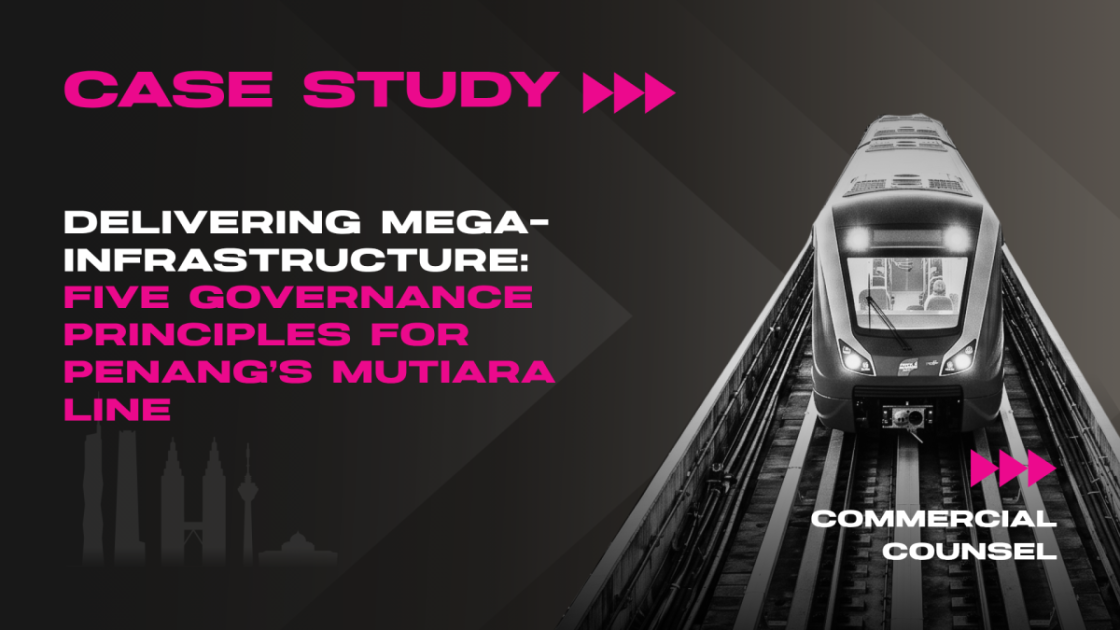
Delivering Mega-Infrastructure: Five Governance Principles for penang’s mutiara line
Delivering Mega-Infrastructure: Five Governance Principles for Penang’s Mutiara Line
Having spent many years advising on construction and infrastructure disputes, I have learned that a claim which eventually lands on a lawyer’s desk almost always began much earlier — as a failure of governance: responsibility left unclear, progress reported too optimistically, an interface left unmanaged, or a warning not escalated while it was still manageable.
The award of the RM3.028 billion System Turnkey Contract for Penang’s Mutiara Line offers a timely lens through which to consider what good governance should look like at the outset of a megaproject—before manageable issues become expensive disputes.
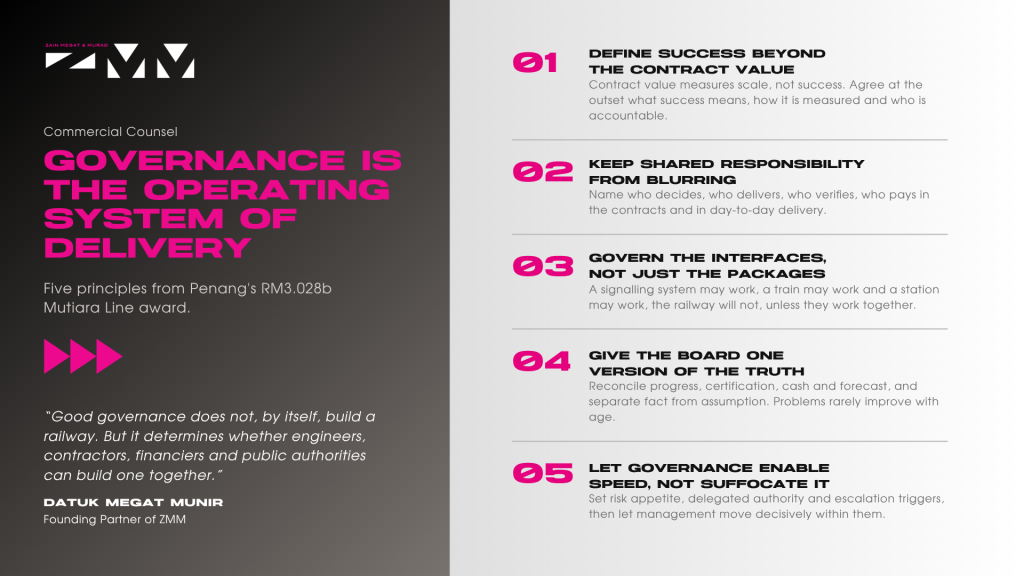
1. Define success beyond the headline contract value
A RM3.028 billion award is undoubtedly a major milestone. But contract value measures scale, not success.
True success means delivering a safe, reliable and maintainable railway within the agreed timeframe and budget, while preserving quality, financial discipline and public confidence. It must create value that lasts — for commuters, the public and every stakeholder involved.
Good governance therefore begins by ensuring that the parties agree from the outset on what success means, how it will be measured and who is accountable for achieving it.
2. Shared responsibility must never become blurred responsibility
Megaprojects bring together the asset owner, the Government, joint-venture partners, contractors, consultants, suppliers, regulators and public authorities. With so many participants, shared responsibility has a way of becoming diluted responsibility.
Governance must clearly establish who decides, who delivers, who verifies, who pays and who bears the financial and legal consequences when something goes wrong. It must address not only the formal allocation of risk in the contracts, but also the practical ownership of those risks during day-to-day delivery.
Who may approve a design change? Who verifies progress? Who bears an overrun? Who must issue the contractual notice? Who is responsible when two packages do not integrate?
A joint venture should combine capabilities without creating gaps into which accountability can disappear.
3. Govern the interfaces, not merely the individual packages
The System Turnkey Contract comprises seven major railway-systems packages, while civil construction and systems design are proceeding in parallel.
Each package may appear to be progressing satisfactorily when viewed on its own, yet the overall project can still falter where one package meets another. A signalling system may work, a train may work and a station may work—but the railway will not work unless they work together.
The interfaces between civil works and railway systems, between design and construction, and between different contractors and technology providers deserve the same rigour as the packages themselves.
That requires named interface owners, an integrated master schedule, common technical and acceptance criteria, clear decision-making deadlines and early escalation when alignment begins to slip.
4. The Board must receive one version of the truth
Physical progress, certified work, revenue recognised, invoices issued, cash collected and forecast profit are related—but they are not the same thing.
Effective Board reporting must reconcile them clearly and distinguish established facts from management assumptions and forecasts. The Board should be able to see the latest estimated cost to complete, forecast project margin, remaining contingency, funding requirement, unresolved variations, potential delay exposure and the decisions requiring its attention.
The purpose of Board reporting is not merely to reassure the Board. It is to equip the Board to make informed decisions while there is still time to influence the outcome.
Problems rarely improve with age. They become more expensive when uncomfortable information travels slowly.
5. Good governance should enable speed, not suffocate it
A megaproject cannot wait for the Board to decide every operational issue. At the same time, urgency cannot justify bypassing controls.
More approvals do not necessarily produce better governance. The Board’s role is to establish the risk appetite, delegated authority, approval thresholds and escalation triggers within which management may act decisively. Management must then have sufficient authority to move quickly within those boundaries, while matters falling outside them are brought promptly to the appropriate level.
Clear procurement disciplines, change-control procedures and reporting obligations should facilitate timely decisions, not become administrative obstacles.
Independent challenge is not an obstacle to delivery. Properly and promptly exercised, it protects delivery from decisions that may later prove costly or irreversible.
Good governance does not, by itself, build a railway. But it determines whether engineers, contractors, financiers and public authorities can build one together.
In a megaproject, governance is not paperwork surrounding delivery. It is the operating system of delivery.
The content of this article does not constitute legal advice. It is intended to provide general information. Specific advice should be sought in relation to your particular circumstances.
Zain Megat & Murad
D2-5-1 to D2-5-3A, Block D, Solaris Dutamas No.1, Jalan Dutamas 1, 50480 Kuala Lumpur
+603 6207 9331 | zmm@zainmegatmurad.com

This site uses Akismet to reduce spam. Learn how your comment data is processed.
Leave a Reply
You must be logged in to post a comment.