


Pupil to Partner: Three Lawyers on What ZMM Actually Taught Them
Pupil to Partner: Three Lawyers on What ZMM Actually Taught Them
At most firms, the partners you see today arrived from somewhere else. They built their names at another address, joined at the right moment, and brought their book of business with them.
ZMM is different.
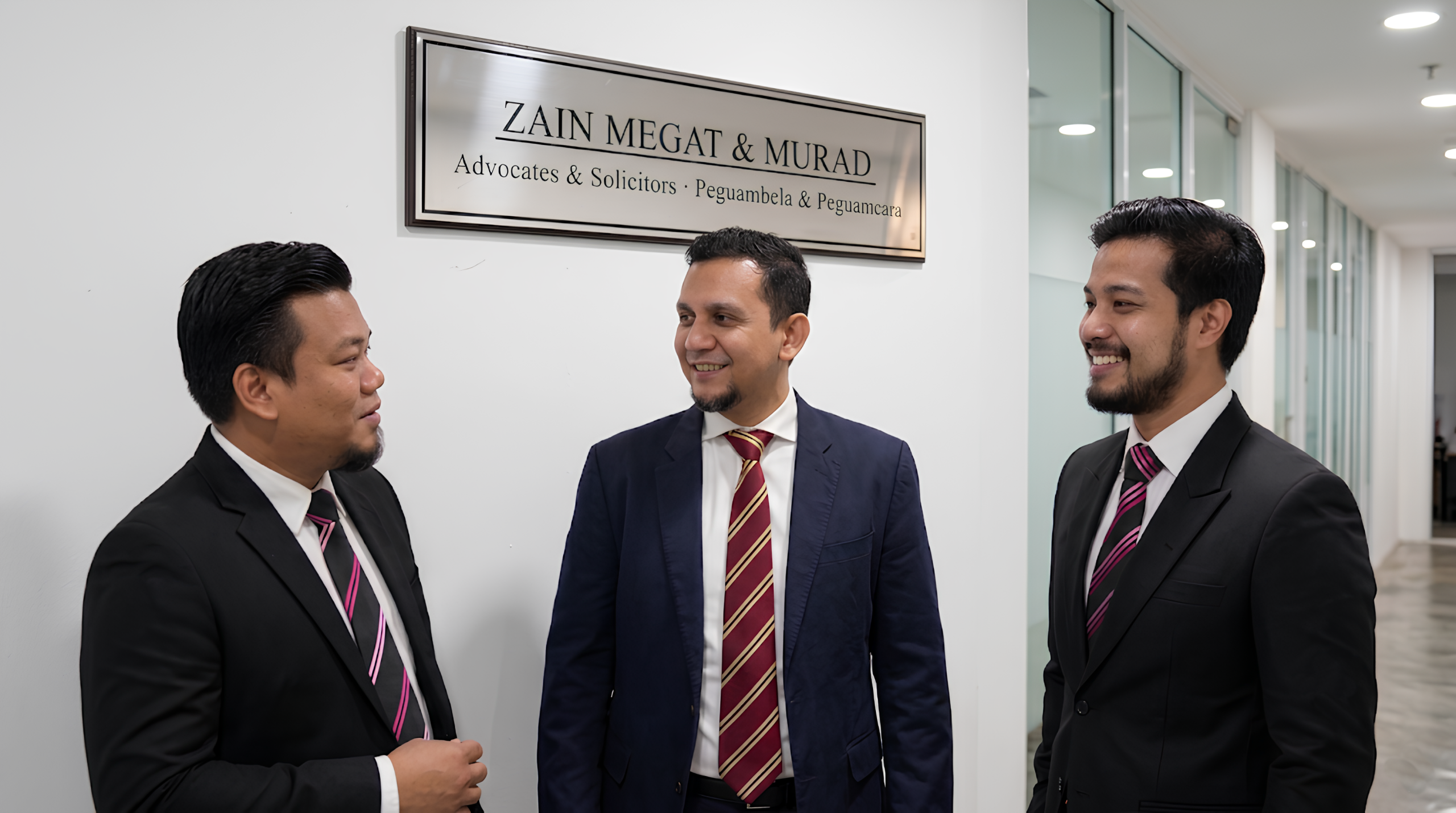
Three of the firm’s partners Shahir Tahir, Asyraf Aziz and Adi Farris started here as pupils. They did their chambering under this roof. They learned to be lawyers within these walls. And in 2023, all three were made partners at the same time.
That is not a coincidence. It is a culture.
First Day Realities
None of them arrived without misconceptions.
Asyraf thought legal practice looked the way it does on television, the composed courtroom, the sharp suit, the drama landing neatly in an hour.
I realised on the first day, that it was nothing like that.
Long hours from day one, a two-pupil office where everyone did everything, and a first court appearance that reminded him quickly that following proceedings in real time was a different skill entirely from watching it on a screen.
Adi’s misconception was about the firm itself. Growing up near Shah Alam, he saw ZMM as a small, local practice, a neighbourhood firm serving its immediate community. It was only after he left, working at another organisation and mentoring chambering students who kept citing ZMM as a firm they had applied to, that he understood what the name actually carried.
I didn't realise the brand was that well-known.
Shahir came in with a precise brief: he wanted a mid-sized firm. Not a large firm where you get lost, not a small one where you drown alone. ZMM looked right on paper. What he didn’t expect was the environment he found.
"It felt like a family, between the partners, the staff, we were all like that. You don't feel the stress the same way when you feel like you're with your own people."
The Culture That Shaped Them
Ask each of them what ZMM gave them that they would not have got elsewhere, and the answers converge on the same themes, even if they arrive at them differently.
For Adi, it was the mentality instilled early: that as a fresh graduate, you don’t come to work to earn, you come to work to learn. He carried that through his entire career. It kept him grounded when the work was hard and unglamorous. It kept him humble enough to learn from support staff, not just from the lawyers above him.
“Suffer in silence,” he says, with a laugh.
The experience pushed him to be self-sufficient earlier than most. It also eventually pushed him to transfer to the KL office, where his appetite for litigation could actually be fed. He did not stay because it was comfortable. He stayed and later returned, because the firm was worth it.
For Asyraf, the defining moment was one he didn’t expect to be defining. He was cited for contempt during a High Court hearing, a serious matter, with serious consequences. What happened next told him everything about the firm. At 2:30 p.m., when he had to return to court to present his case before the judge delivered her verdict, he did not go alone. Datuk Megat was there. Alan was there. Senior associates were there, not because anyone asked them to be, but because that is what the firm does. It closes ranks.
We protect each other, that is the culture.
Shahir adds a counterpart to that: meritocracy. Protection runs alongside a discipline about credit. He describes being a partner on a complex matter, working alongside a senior partner, when it was a pupil, the most junior person in the room, who found the case that would support their argument. The partner did not absorb the credit. The pupil was named, acknowledged, given their due in front of the people who mattered.
We don't take credit without saying who found it.
Done consistently, that standard builds something in a team that no policy document can manufacture.
And then there is speed. Shahir discovered its value when he briefly went in-house. He submitted work quickly and was met with confusion, why so fast? At ZMM, that pace was not exceptional. It was the baseline. Fast, meticulous and efficient, not as competing demands but as one standard.
You learn to be fast and still be thorough, once that is in you, it doesn't leave.
Leaving and Coming Back
Both Shahir and Adi left the firm at different points in their careers.
Shahir went in-house for a year. He took on a different designation, served his notice and experienced what life looked like in a large corporate environment. What he missed was the thing he had not known to value until it was gone. “That family spirit, it was not there,” he says. When the call came to return, the decision was easy. He did not need to think it over.
Adi left to step outside his comfort zone and because the Shah Alam branch, where his father is the founder, was built on corporate and conveyancing work and Adi wanted litigation. He spent three years at another organisation, doing construction disputes, arbitration, adjudication. When he came back in 2018, he brought that with him and used it to expand what Shah Alam could offer. The return was not nostalgic. it was purposeful. His father is in his seventies. The branch is, in a real sense, a family business and there is a legacy to build. “There was a calling for me to come back,” he says. “To learn the ropes. To try to fill in the shoes he has made for himself.”
Asyraf never formally left, but he relocated, opening the firm’s Alor Setar branch to balance family life, while still travelling to KL regularly. The branch exists because Datuk Megat made the offer: rather than resign, use the brand, use the panel memberships and build something in the north. “He saw something in me,” Asyraf says. “That I could deliver here.”
What They Tell the Younger Generation
All three have seen the generational shift. Pupils coming in now are more comfortable than their predecessors and not always more equipped.
Adi puts it directly: the biggest difference he sees between his generation and the current one is resourcefulness. Back when he was training, finding a useful case meant going to a library, pulling out an actual journal and working through it page by page. That friction taught something
Law school gives you maybe 20% of what you need, the other 80% is resourcefulness, knowing how to find what you need, think for yourself and handle a matter when no one is holding your hand.
Shahir’s advice is simpler and it cuts against the pride that holds a lot of young lawyers back: ask. Ask before you start. Understand what is actually required before you go looking for it. “You cannot be resourceful,” he says, “if you do not know what you are supposed to be looking for.” There is no stupid question, handled with the right intention. The risk is not in asking, it is in pretending you already know.
Asyraf brings it back to mentality. The hours are long. The pressure is real. The glamour, if there ever was any, disappears fast. Younger lawyers who come in expecting something polished will hit that wall. The ones who make it are the ones who are prepared for it, who understand, going in, that practice is a craft that takes time and that the time is part of the price.
What They Are Building Towards
In ten years, these three want something specific.
Asyraf wants ZMM to be the largest law firm in the Northen region. It is a clear, competitive goal and it comes with a clear competitor in mind. Bigger cases, more personnel, a stronger regional presence. It is the kind of ambition the firm’s founding generation would recognise.
Adi’s horizon is longer. In the next twenty to twenty-five years, he wants ZMM to stand among the largest Bumiputera law firms in Malaysia with a majority of Bumiputera and Malay practitioners and a service range broad enough to cover corporate, housing and development, construction and energy and eventually a company secretarial function. Scale, in his view, is not the end, it is the mechanism. A bigger firm can offer a broader range. A broader range builds reputation across more industries. Reputation compounds.
Shahir’s vision is about something harder to measure, but unmistakable when it arrives. He wants the ZMM name to carry weight in the room before anyone speaks. Not individual partners, not a single senior, the firm itself. “In ten, twenty-five years, I want the other side to see our name on a matter and think: we have to be careful here. We have to work.” Right now, certain partners carry that weight. The goal is for the name to carry it on its own.
Asyraf says it plainly: the brand and the work have to move together. One without the other does not last.
Three lawyers. Thirty-five combined years of practice between them at this firm. All made partner in the same year, from the same pipeline, shaped by the same culture.
That is not something you build by accident. It is something you earn over 25 years by deciding, early and consistently, that the people you grow are worth keeping.
ZMM, 25 years. The same faces, deeper than ever.
This site uses Akismet to reduce spam. Learn how your comment data is processed.
Leave a Reply
You must be logged in to post a comment.